
The Worthing War Memorial: The Stories Behind the Names
4 Nov, 2026
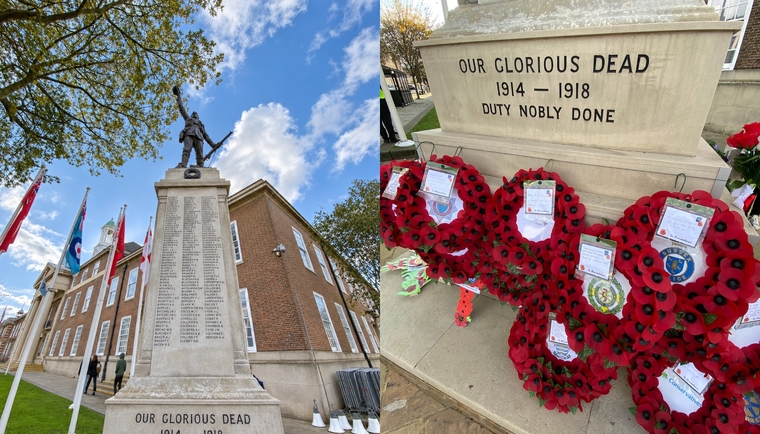
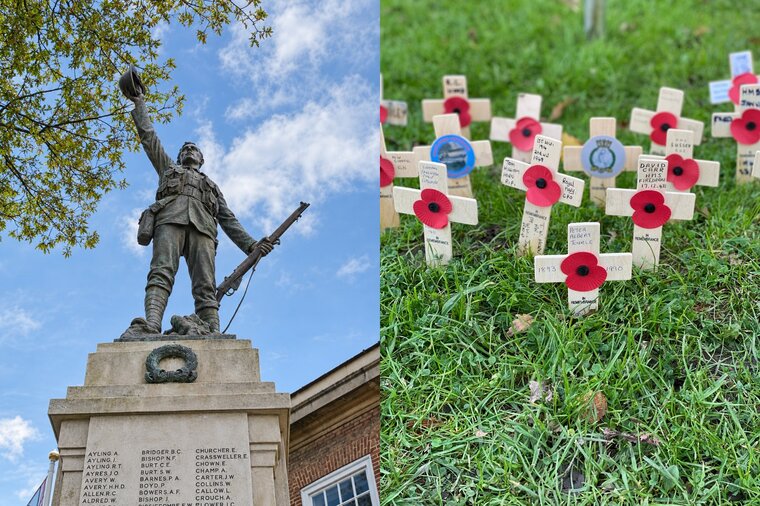
In the centre of Worthing, on Chapel Road outside the Town Hall, stands one of the town’s most moving landmarks. Above its stone pedestal, a bronze soldier raises his helmet in one hand while holding his rifle in the other. Beneath him are hundreds of names: people who once lived in the streets of Worthing, attended its schools, worked in its shops and businesses, and belonged to families whose lives would never be the same again.
To a passer-by, those inscriptions may appear to be simply a list. Yet each name represents a person with a home, a family and a story in Worthing. The memorial is more than a monument to military sacrifice: it is a record of the enormous human cost of war to one Sussex seaside town.
How Worthing’s war memorial came to be
The First World War ended in November 1918, but bereaved families faced years of mourning. Many servicemen had been buried near the battlefields in France and Belgium or lost at sea. Their relatives often had no grave in Britain they could visit. Across the country, towns and villages responded by creating public memorials where communities could remember their dead together.
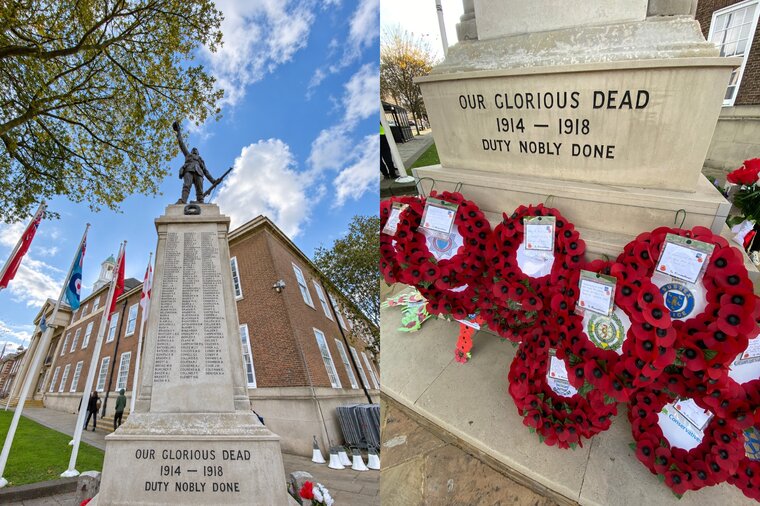
Worthing’s memorial was funded by public donations collected through the Worthing Gazette. It was made by Joseph Whitehead and Sons and unveiled on 11 April 1921 by Field-Marshal Sir William Robertson. Its design is striking, a bronze infantryman, rather than a distant allegorical figure, stands above a tall stone plinth with wreaths on its sides. The inscriptions include the words “Our Glorious Dead” and “Duty Nobly Done.”
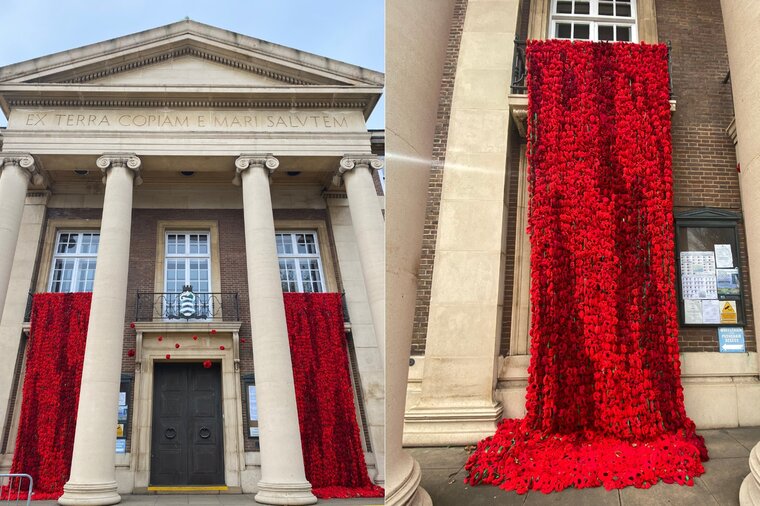
The town's present Town Hall was built in 1933–34, after the memorial's unveiling, but the monument now forms a familiar part of the civic setting outside it. In June 2017, the memorial received Grade II listed status in recognition of its architectural and historical importance.
Historic England records 660 names from the First World War and a further 404 from the Second World War. Names from later conflicts have also been added. The memorial thus represents a continuing tradition of remembrance, rather than a monument frozen in 1921.
The remarkable records behind the inscriptions
One of the most valuable sources for understanding the Great War in Worthing is the collection of memorial application forms described by local historian Chris Hare. His original account reported that more than 600 forms were preserved at Worthing Museum. Relatives completed them when seeking to have the names of loved ones included on the new memorial.
Some entries supplied little more than a name, rank or date of death. Others recorded a home address, years of service or a few painful details about the circumstances of a death. These small fragments can tell us things an inscription cannot. They reconnect the fallen with familiar places such as Tarring Road, Teville Road, Church Walk, Elm Grove and Penfold Road.
The forms are also a reminder that the monument was shaped by families. Behind every submitted name was someone determined that a son, husband, brother or father should not disappear from the town’s memory.
The first losses, and the last days of the war
According to Hare’s research, one of Worthing’s earliest war-related deaths occurred at home, not on a foreign battlefield. Arthur Wright, of Church Walk, died on 14 August 1914, only ten days after Britain entered the war. The family record described him as protecting the railway line, but gave no clear explanation of how he died. His story shows how wartime duties could bring danger even to those who had not gone overseas.
At the other end of the conflict is the particularly poignant story of Frederick Charles Dredge, a 20-year-old Royal Navy stoker whose family lived in Elm Grove. He was serving aboard HMS Britannia when the battleship was torpedoed by a German submarine near the Strait of Gibraltar on 9 November 1918, just two days before the Armistice. Hare recorded that the news reached his family on 11 November, the very day people were celebrating the end of the fighting.
Frederick is also commemorated on the Portsmouth Naval Memorial. His story captures the painful contradiction of Armistice Day: while crowds welcomed peace, some households were only just learning that a loved one would never return.
The day Sussex died: Richebourg, 30 June 1916
Few episodes show the scale of Sussex’s losses more starkly than the Battle of the Boar’s Head, fought at Richebourg-l’Avoué in northern France on 30 June 1916. It took place one day before the opening of the Battle of the Somme and was intended to divert German attention from the main offensive.
Men of the 11th, 12th and 13th Battalions of the Royal Sussex Regimen, the South Downs battalions, often nicknamed Lowther’s Lambs, were drawn into the attack. Many had enlisted alongside friends or neighbours from their home county. In roughly five hours of fighting, 366 officers and men were killed, with more than a thousand others wounded or taken prisoner, according to Adur & Worthing Councils’ account. The date became known as “the day that Sussex died.”
For Worthing, the grief was intensely personal. Historian Paul Reed’s account, published by Bexhill Museum, describes the tragedy of the Pannell family. Three brothers William, Charles and Alfred Pannell were killed in the action, while a fourth brother was taken prisoner. The three who died had no identified graves and were commemorated on the Loos Memorial to the Missing. Other Worthing families, including the Blakers, also lost more than one son in the battle.
Such losses were felt across entire streets, workplaces and congregations. The destruction of units recruited from the same communities meant that the news from France could bring several bereavements to one neighbourhood at almost the same time.
Worthing has a separate memorial to the Battle of the Boar’s Head in Beach House Park, created by students from Chatsmore Catholic High School and installed for the battle’s centenary in 2016. It provides another local place to remember the Sussex men who died on that June morning.
Worthing men at sea and across the world
The memorial also reveals the extraordinary geographical reach of the war. Worthing men did not serve only in the trenches of France and Belgium. They were sent to sea, to India and to Mesopotamia, present-day Iraq and some died far from the battlefields most commonly associated with 1914–18.
Charles Ernest Alfred Tuck, of Teville Road, was only 18 when he died aboard HMS Hampshire on 5 June 1916. The ship was carrying Lord Kitchener, the Secretary of State for War, towards Russia when it struck a German mine in stormy seas off Orkney. The Royal Navy records 737 lives lost and just 12 survivors. Tuck’s death brought a nationally famous disaster directly into the history of one Worthing family.
Other entries in Hare’s research raise questions that have never been fully answered. William Daughtrey was reported to have been killed by a fellow serviceman in India in January 1915, the surviving description does not establish whether the incident was deliberate or accidental. Corporal Herbert Carpenter was said to have died of “heartbreak” in Mesopotamia in August 1918. That evocative phrase tells us something of how his death was understood or reported, but it is not a medically established cause. George Swain, of Winton Place, was described as killed in action in “Tower Hamlets” in November 1917. Without corroborating records, it would be unwise to assume that this referred to an air raid or even to a particular location.
These uncertainties matter. They are invitations to further research, not gaps to fill with guesswork. Service records, local newspapers and Commonwealth War Graves Commission entries may help future historians piece together fuller stories.
The suffering did not end on 11 November
The Armistice stopped the fighting on the Western Front, but it could not instantly heal wounds or reverse years of physical exhaustion and disease. Some men died months after the guns fell silent, from injuries or illnesses aggravated by their service. Hare identified nearly thirty such names on the Worthing memorial.
James Butcher, of Penfold Road, had spent around nineteen years in the British Army. After surviving the dangers of wartime service, he died in March 1919. John Bishop, of The Drive, was a veteran of earlier imperial campaigns in Africa and India. He died from pneumonia aged 52, making him one of the older men discussed in Hare’s original research.
Their deaths underline an important truth: the First World War did not have a neat ending for those who had fought in it. Families continued to lose loved ones after November 1918, while survivors lived with injuries, illness and memories that might last a lifetime.
A memorial created by families, remembered by a town
One especially touching detail comes from the relatives of Herbert Short, of Tarring Road, who died in France in March 1918. Writing about a proposed commemorative certificate, they expressed thanks to the Town Council and said it was something they would be proud to receive. The words leave us wondering what such a certificate meant to a household that had already lost so much: perhaps an official recognition of sacrifice, a small object to preserve, or simply reassurance that Herbert had not been forgotten.
More than a century after the memorial was unveiled, people still gather beside it for Armistice Day and Remembrance Sunday. Wreaths and silence link present-day Worthing with the families who first submitted those names. The monument also reminds us that the war’s effects extended well beyond the 660 First World War inscriptions: into homes, livelihoods, friendships and generations of family history.
Next time you pass the Worthing War Memorial in Chapel Road, look beyond the bronze soldier and the familiar inscriptions. Think of Arthur Wright guarding a railway in the first days of war; the Pannell brothers at Richebourg; young Charles Tuck lost off Orkney; Frederick Dredge whose family received dreadful news on Armistice Day; and the veterans who died after peace was announced.
They were not simply names carved into stone. They were Worthing people, and their stories remain part of our town.
Sources and further reading
- Chris Hare, “The War Memorial in Worthing” (21 July 2014) — original article published on www.robertluff.co.uk
- Historic England: Worthing War Memorial, Grade II listing — design, sculptor/maker, unveiling, inscriptions and numbers commemorated.
- Adur & Worthing Councils: Battle of the Boar’s Head — battle date, participating battalions, casualties and local commemoration.
- Paul Reed, “The Battle of Boar’s Head”, Bexhill Museum — detailed Sussex regimental and family history.
- Royal Navy: Centenary of the sinking of HMS Hampshire — circumstances and losses.
- Adur & Worthing Councils: Remembrance services — the memorial’s continuing civic role.
Historical note: The application forms and their particular wording are described in Chris Hare’s published research; this expanded article does not claim to have re-examined the original archive. Where a cause or circumstance remains uncertain, it is identified as such.